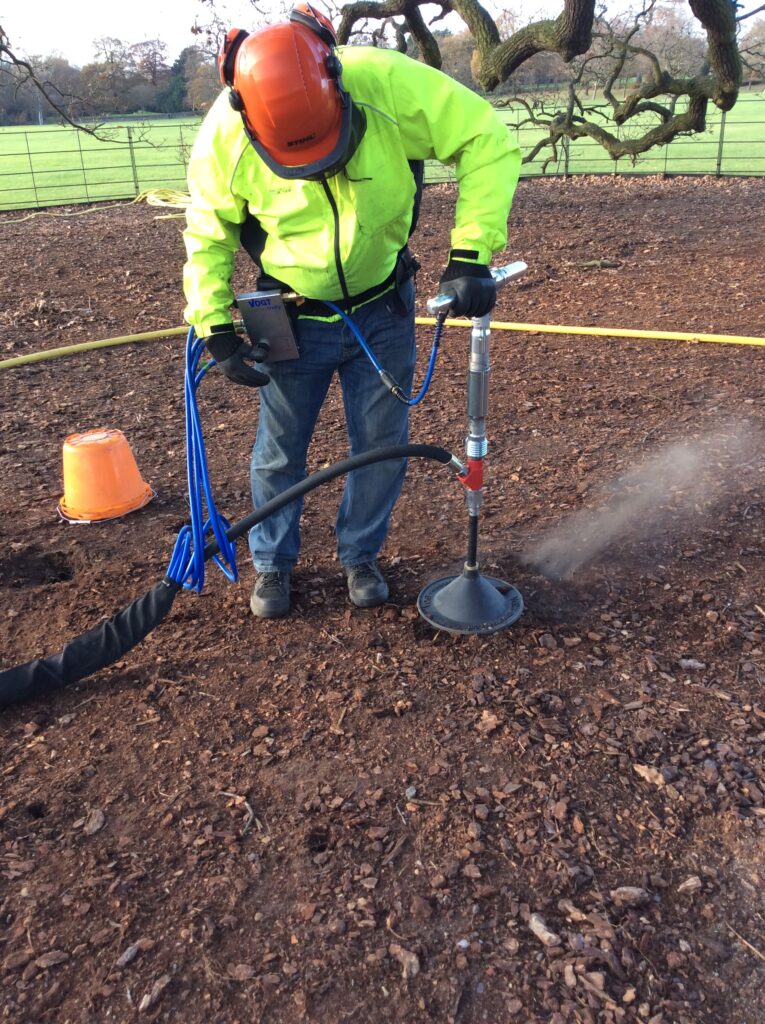
A greenkeeper in Devon decided to stop feeding one of his greens. On purpose.
Okehampton Golf Club trialled biochar for golf greens on two of their surfaces, including their notorious disease indicator green: the shaded one in the valley that catches every problem first. If something is going to go wrong on the course, it shows up there before anywhere else.
The results from the trial areas gave the greenkeeping team something they had not expected. They skipped a fertiliser application on the treated green and could not tell the difference three weeks later.
What the biochar for golf greens trial showed
Across the trial year, Okehampton reported the following from the treated areas:
- A 20% reduction in fertiliser use. The treated green held nutrient so well that one feed was missed entirely with no visible impact on surface quality.
- No fungicide required on the trial areas across the full trial year, including on the disease indicator green.
- Faster drainage when wet and better moisture retention through dry spells, on the same surface.
To be clear: these are the club’s reported results from specific trial plots, not a controlled multi-site study. Outcomes vary with soil type, climate and specification. But the pattern is consistent with what we see across other sports turf applications.
Why enriched biochar behaves differently on a green
A century ago, greenkeepers brushed charcoal into their greens as standard practice. The instinct was right. The problem with plain charcoal, and with plain biochar today, is that it arrives biologically empty. In its first season it acts as a dry sponge, pulling nitrogen and beneficial microbes out of the rootzone before it has anything to contribute.
Enriched biochar is different because it arrives pre-charged with mycorrhizal fungi and beneficial bacteria. Rather than borrowing from the soil, it introduces biology from day one. The mycorrhizal networks extend the root system, improving both nutrient uptake and water movement through the profile. That is why you can see faster drainage and better drought tolerance from the same surface: the root system is doing more work, more efficiently.
The reduction in fertiliser and fungicide use follows from the same mechanism. Healthier roots in a more active soil food web are less dependent on external inputs and more resistant to the stress conditions that create disease pressure.
What this means for greenkeeping budgets
Sports turf managers increasingly face pressure to reduce inputs: fewer synthetic fertilisers, reduced fungicide programmes, lower overall maintenance costs. Enriched biochar does not replace a greenkeeping programme, but trials like Okehampton’s suggest it can meaningfully reduce how much that programme costs to run year on year.
The principle is the same whether the surface is a golf green, a bowling green, a cricket outfield or a football pitch. Feed the soil biology, and the surface looks after itself more.